

Have you ever wished for a function to exist in Terraform but it simply wasn’t there? Fret no more! Terraform 1.8 was released last week and includes the general availability of Provider Functions. This feature allows you to write your own functions in Go and use them in your Terraform configuration. This is a game changer for Terraform and I’m excited to see what the community comes up with.
I decided to try this out for myself using inspiration from the fibonacci sequence and memoization that I wrote about with respect to Python. I closed the hashicorp/terraform-provider-scaffolding-framework repository and got to work.
My initial intent was just to write a function called “fib” that would generate the fibonacci sequence number given an input. It took me down a rabbit hole learning even more about the type system implemented in HCL. The tutorial provided by HashiCorp walks through creating the “hashicups” provider. I loosely used it as a starting point, but I quickly lost interest because they walk you through, line by line, modifying the “template”. No thanks. I wrote a Bash script called scaffold-terraform-provider.sh to handle that.
./scaffold-terraform-provider.sh mathI named my provider “math” to keep it generic and include additional functions within that space to use it like a library/package.
Functions
Creating provider functions should follow the format of making a new file in “internal/provider” and naming it for the function (e.g. “fib_function.go”). I copied the example_function.go file and then proceded to modify it by searching for “ExampleFunction” and replacing with “FibFunction”.
A function is registered to the provider with a creation of a new function called “NewFibFunction” that returns the “function.Function” type:
func NewFibFunction() function.Function {
	return &FibFunction{}
}
Then, the Metadata method needs to be called that returns the function metadata:
func (f *FibFunction) Metadata(ctx context.Context, req function.MetadataRequest, resp *function.MetadataResponse) {
	resp.Name = "fib"
}
The Definition method is used to create your input and return types:
func (f *FibFunction) Definition(ctx context.Context, req function.DefinitionRequest, resp *function.DefinitionResponse) {
	resp.Definition = function.Definition{
		Summary:             "Fibonacci sequence",
		MarkdownDescription: "Accepts a number and returns the result of the fibonacci sequence at that index.",
		Parameters: []function.Parameter{
			function.NumberParameter{
				Name: "number",
			},
		},
		Return: function.NumberReturn{},
	}
}
The “fib” function is rather simple because it takes a single input and returns a value. Everything uses the different types that are part of the provider framework.
To execute the function, you implement the Run method:
func (f *FibFunction) Run(ctx context.Context, req function.RunRequest, resp *function.RunResponse) {
	var number *big.Float
	var result *big.Float

	// Read Terraform argument data into the variables
	resp.Error = function.ConcatFuncErrors(resp.Error, req.Arguments.Get(ctx, &number))

	fibInt, _ := number.Uint64()
	result = big.NewFloat(0).SetUint64(fib.Fib(fibInt))

	resp.Error = function.ConcatFuncErrors(resp.Error, resp.Result.Set(ctx, result))
}
The tricky part is that everything implements the data types from the go-cty package. So, Terraform “number” data type is implemented as a big.Float, from the “math/big” standard library package.
In order to simplify everything, I put my actual implementation of the fibonacci sequence in a separate package called “fib” and imported it into the function file (the package is in “internal/fib”). This allowed me to test the function in isolation from the provider.
package fib

var cache = make(map[uint64]uint64)

func Fib(n uint64) uint64 {
	if n < 2 {
		return n
	}

	if _, ok := cache[n]; !ok {
		cache[n] = Fib(n-1) + Fib(n-2)
	}
	return cache[n]
}
The final requirement to register the function is to update the “internal/provider/provider.go” file:
func (p *MathProvider) Functions(ctx context.Context) []func() function.Function {
	return []func() function.Function{
		NewFibFunction,
	}
}
To test it, I had to create a `~/.terraformrc` file to overwrite the provider path and source it locally:
provider_installation {

  dev_overrides {
      "hashicorp.com/edu/math" = "/Users/dustindortch/go/bin"
  }

  # For all other providers, install them directly from their origin provider
  # registries as normal. If you omit this, Terraform will _only_ use
  # the dev_overrides block, and so no other providers will be available.
  direct {}
}
Now, I am able to build:
go install .After this, I created a simple Terraform configuration to test the function:
terraform {
  required_providers {
    math = {
      source = "hashicorp.com/edu/math"
    }
  }
}

output "sequence" {
  value = provider::math::fib(12)
}
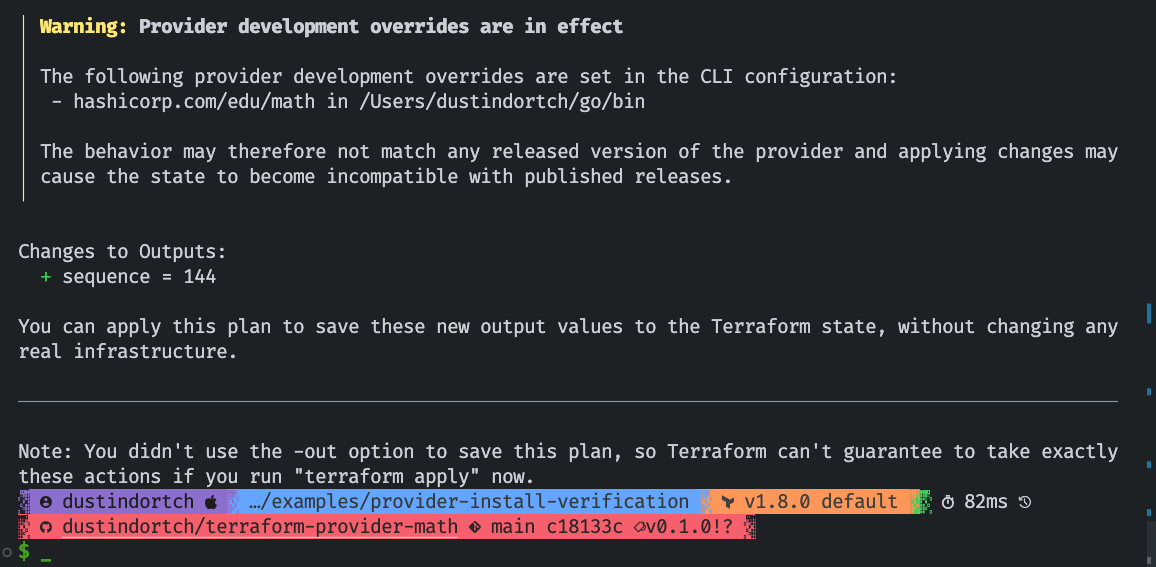
For the moment of truth:
terraform planAnd the results:
Resources
To contrast the behavior between functions and resources, I also implemented a resource called “math_fib” that uses the same “fib” pacakge. The main difference is that the resource is written to state and won’t update unless there is a change that requires it to be replaced. A function does not get [directly] written to state (only if it is the input to some other resource that is written to state).
I created a new resource file “internal/provider” and naming it for the resource (e.g. “fib_resource.go”).
I am not going to go into as many details here, but following are some highlights.
A data structure must be created that includes the inputs and outputs of the resource:
type FibResourceModel struct {
	ID     types.String `tfsdk:"id"`
	Number types.Int64  `tfsdk:"number"`
	Result types.Int64  `tfsdk:"result"`
}
The Metadata method to name the resource:
func (r *FibResource) Metadata(ctx context.Context, req resource.MetadataRequest, resp *resource.MetadataResponse) {
	resp.TypeName = req.ProviderTypeName + "_fib"
}
A detailed schema is created with the Schema method:
func (r *FibResource) Schema(ctx context.Context, req resource.SchemaRequest, resp *resource.SchemaResponse) {
	resp.Schema = schema.Schema{
		// This description is used by the documentation generator and the language server.
		MarkdownDescription: "The resource `math_fib` generates the fibonacci number from a given number.",

		Attributes: map[string]schema.Attribute{
			"number": schema.Int64Attribute{
				MarkdownDescription: "The number to calculate the fibonacci sequence",
				Required:            true,
				PlanModifiers: []planmodifier.Int64{
					int64planmodifier.RequiresReplace(),
				},
			},
			"result": schema.Int64Attribute{
				MarkdownDescription: "The result of the fibonacci number calculation.",
				Computed:            true,
				PlanModifiers: []planmodifier.Int64{
					int64planmodifier.UseStateForUnknown(),
				},
			},
			"id": schema.StringAttribute{
				Computed:            true,
				MarkdownDescription: "The string representation of the fibonacci number result.",
				PlanModifiers: []planmodifier.String{
					stringplanmodifier.UseStateForUnknown(),
				},
			},
		},
	}
}
The Create method does the hard work by getting the plan data, performing any necessary operations, and then writing the result to the state:
func (r *FibResource) Create(ctx context.Context, req resource.CreateRequest, resp *resource.CreateResponse) {
	var data FibResourceModel

	// Read Terraform plan data into the model
	resp.Diagnostics.Append(req.Plan.Get(ctx, &data)...)

	if resp.Diagnostics.HasError() {
		return
	}

	result := int64(fib.Fib(uint64(data.Number.ValueInt64())))

	// For the purposes of this example code, hardcoding a response value to
	// save into the Terraform state.
	data.ID = types.StringValue(strconv.FormatInt(result, 10))
	data.Result = types.Int64Value(result)

	// Write logs using the tflog package
	// Documentation: https://terraform.io/plugin/log
	tflog.Info(ctx, "created a resource")

	// Save data into Terraform state
	resp.Diagnostics.Append(resp.State.Set(ctx, data)...)
}
The other operations are fairly generic. The one thing that I did do, otherwise, is remove the call to the Configure method because my provide isn’t communicating with any API endpoint, similar to the Random provider.
Back in the “internal/provider/provider.go” file, I added the resource to the list of resources:
func (p *MathProvider) Resources(ctx context.Context) []func() resource.Resource {
	return []func() resource.Resource{
		NewFibResource,
	}
}
Aside from that, I generated the documentation:
go generate ./...Then, it was simply (an understatement to be sure) a matter of creating my repository, committing and pushing the code, generating a GPG signing key and importing the requisite details as GitHub Secrets, and then creating a release.
The last thing I did was added my GPG public key to my Terraform Registry account and then I published.
I made a new directory to test the code:
terraform {
  required_providers {
    math = {
      source = "dustindortch/math"
    }
  }
}

resource "math_fib" "sequence" {
  number = 9
}

output "result" {
  value = math_fib.sequence.result
}

output "sequence" {
  value = provider::math::fib(12)
}
The run it:
terraform init
terraform apply -auto-approve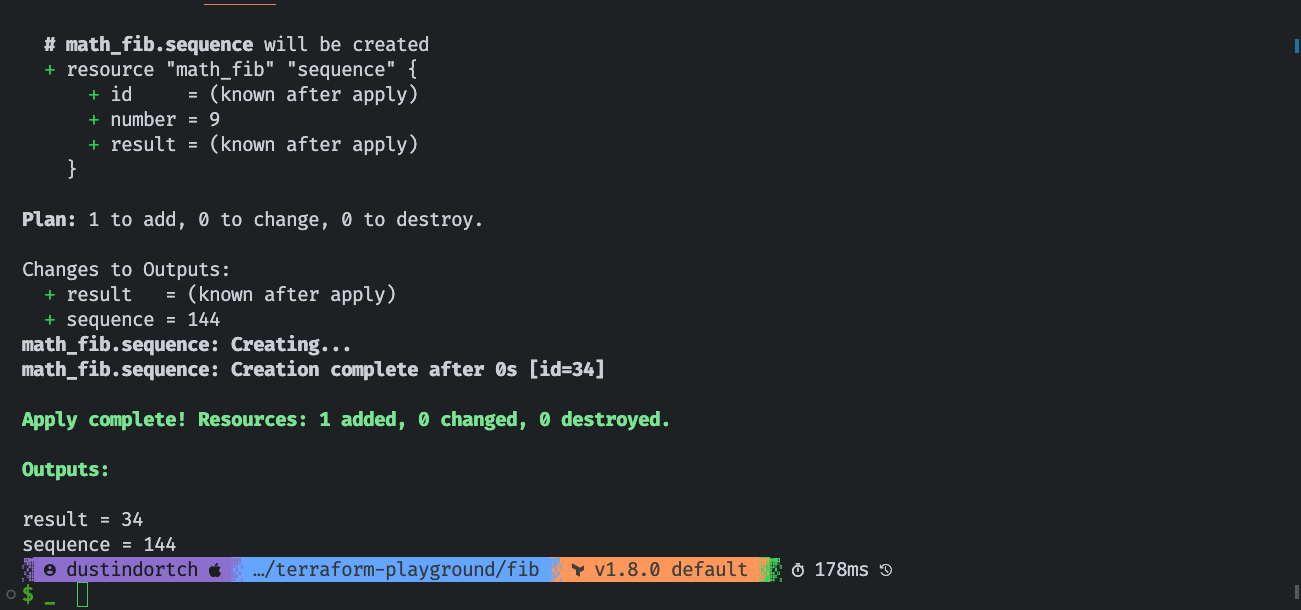
Conclusion
Functions were not a huge hurdle to overcome. If you have any ideas about functions that you would like to see, please let me know. I am looking for a few ideas to add to my “math” provider.
 Dustin Dortch